Federal minister, DeepL and OpenAI
leadership, and Germany’s quantum frontrunners spearhead multinational speaker
programme at Messe Berlin
BERLIN,
Germany, 23 June 2026: Germany is spearheading a
power-packed speaker delegation at GITEX AI EUROPE 2026, as government,
big tech and scale-up leaders, quantum frontrunners and investors take
centre-stage when Europe’s most global tech and startup event opens next week
in Berlin.
German
leaders comprise 60 percent of the event’s 150-plus expert speakers, drawn from
a line-up spanning 33 countries across Europe, North America, Asia and Africa.
That’s in addition to a powerhouse exhibition, featuring 950-plus enterprises
and startups and 600-plus investors from more than 80 nations to accelerate investment across a European tech market
forecast to surpass €1.5 trillion in 2026.
GITEX
AI EUROPE takes place from 30 June-1 July 2026, with the
conference programme running across three stages and five themes: DeepTech
& Critical Supply Chains, on securing Europe’s industrial backbone; Compute
& AI Stack, on the route from foundation models to enterprise deployment;
Secure Infra & Cyber Power, on AI-era defence and quantum resilience;
Capital & Scale-Up Engine, on Europe’s new funding playbook; and Policy to
Production, on turning EU AI Act regulation into competitive advantage.
Thirteen
German speakers anchor the headline sessions, mapping onto the five-theme
structure: from policy and infrastructure questions opening the show, through
enterprise deployment and quantum resilience, to the capital deciding what gets
built next.
DeepTech
& Critical Supply Chains and Policy to Production
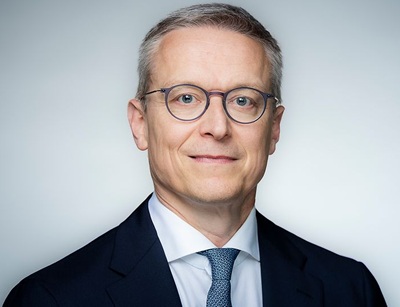
Dr.
Karsten Wildberger, Federal Minister for Digital Transformation and Government
Modernisation, opens with a Main Stage fireside, ‘The Gigawatt Guarantee:
Engineering Europe’s Industrial AI Supremacy,’ at 11.00–11.30am, on the
industrial capacity question underpinning the DeepTech & Critical Supply
Chains theme.
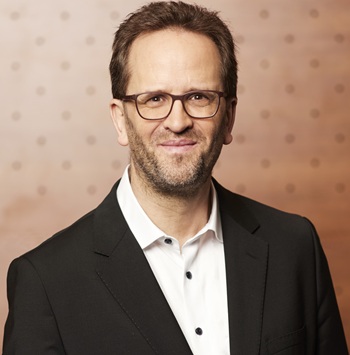
Klaus Müller, President of the Bundesnetzagentur and leading German implementation of the EU AI Act, follows with a 10.00–10.30am Intelligence Stage panel on 1 July, ‘Who Controls Computing When AI Outgrows Europe’s Grids and Networks?’ with a direct read on the Policy to Production theme.
Enterprise
and AI leadership: Compute & AI Stack
Prof.
Dr. Robert Mayr, CEO and Chairman of the Board at DATEV eG, speaks on the Main
Stage on 30 June from 12:30-12:50pm in ‘Transformation in Practice: How
Technology Creates Real Value Through Application,’ arguing AI can sharpen
efficiency and decision-making for SMEs under cost and structural pressure, provided
regulation doesn’t choke off innovation.
Mayr
said: “Europe has excellent prerequisites, with highly qualified professionals
and a large common economic area. The crucial point is that we don’t stifle
innovation in Europe through overregulation.”
Dr.
Jarek Kutylowski, CEO of DeepL, used by more than 200,000 clients, and one of
Europe’s biggest AI unicorns, follows with a Main Stage fireside, ‘Europe’s AI
Advantage: Building Intelligence Infrastructure That Competes Globally,’ at
1.10–1.30pm on 30 June.
Niklas
Harzheim, GTM lead for OpenAI in the DACH region, Tomáš Vocetka, CTO of travel
platform Omio, and Daniel Khachab, Co-founder and CEO of Choco then sit on a
3.20–4.00pm panel the same day, ‘Language Models as Europe’s New Economic
Infrastructure,’ on how foundation models move from pilot to enterprise-wide
deployment, delving into Compute & AI Stack theme’s central question.
Harzheim
said: “Working with digital-native companies in Germany and across Europe, I am
thrilled to see AI moving from experimentation into the core of how businesses
build products, serve customers and operate. The opportunity now is to turn
those strengths into deployment at scale, and pilot projects into real business
impact.”
Vocetka,
addressing Europe’s regulatory and operational fragmentation, said: “Europe has
a long history of building businesses in complex environments... AI is well
suited to those environments. In its own way, Europe’s fragmentation is now its
competitive advantage in the AI era.”
Rickard
Damm, SVP, Consumer AI – Product Marketing at Deutsche Telekom, joins a
2.30–3.00pm Main Stage panel on 30 June, ‘AI at the Network Layer,’ exploring
how Europe’s leading network operators are embedding AI at infrastructure
level.
Quantum
and cybersecurity: Secure Infra & Cyber Power
Three
German quantum leaders converge on sovereign infrastructure, the throughline of
the Secure Infra & Cyber Power theme. Dr. Markus Pflitsch, CEO of the $3.25
billion Nasdaq-bound Terra Quantum, and a former CERN physicist, opens with a
10.20–10.40am fireside on day two (1 July), ‘Which Quantum Infrastructure
Should Europe Truly Own.’ Dr. Katrin Kobe, CEO of Bosch Quantum Sensing,
developing Europe’s flagship diamond-based quantum sensor platform, and Dr.
Alexander Glätzle, CEO of planqc, a Max Planck Institute spinout building
Germany’s first commercial neutral-atom quantum computers, then join a 2.25–3.05pm
panel on 1 July, ‘Quantum Is the Bet European Leaders Should Not Delay,’
arguing quantum-resilient infrastructure can’t wait for the technology to
mature.
Capital: Capital & Scale-Up Engine
Stefan
B. Wintels, CEO of KfW, Germany’s largest development bank, managing a €1
billion growth fund, opens this theme with an 11.20–11.40am fireside on 1 July,
‘Germany’s Capital Engine as a World Example,’ positioning German state-backed
financing as a template for the continent. Florian Heinemann of Project A,
Europe’s largest operational VC with €1.2 billion AUM and 130+ portfolio
companies, follows with a 3.35–4.10pm panel the same day, ‘Can Europe Lead in
Deeptech Research and Still Win at Series B?’, confronting the growth-stage
funding gap the Capital & Scale-Up Engine theme is built to address.
Together,
the thirteen sessions trace a single arc: from the regulatory and
infrastructure foundations of European AI, through enterprise deployment, to
the capital deciding what gets built next.
GITEX
AI EUROPE is organised by inD, the joint venture between
Dubai World Trade Centre and Informa, and the global organiser of GITEX, the
world's largest tech and AI event network. The annual two-day event is
supported by the Berlin Senate Department for Economics, Energy and Public
Enterprises and Berlin Partner for Business and Technology.